

Roof replacement is defined as the full removal of your existing roofing system and the installation of a new one, covering materials, labor, underlayment, flashing, ventilation, and cleanup. It's not just swapping out shingles. A complete roof replacement involves multiple layers and components working together to protect your home for decades. Knowing what's included helps you read quotes accurately, budget realistically, and avoid the unpleasant surprise of a contractor asking for more money mid-project.
What does roof replacement include in terms of materials and layers?
A standard roof replacement includes far more than the shingles you see from the street. The full system is built in layers, and each one has a specific job.
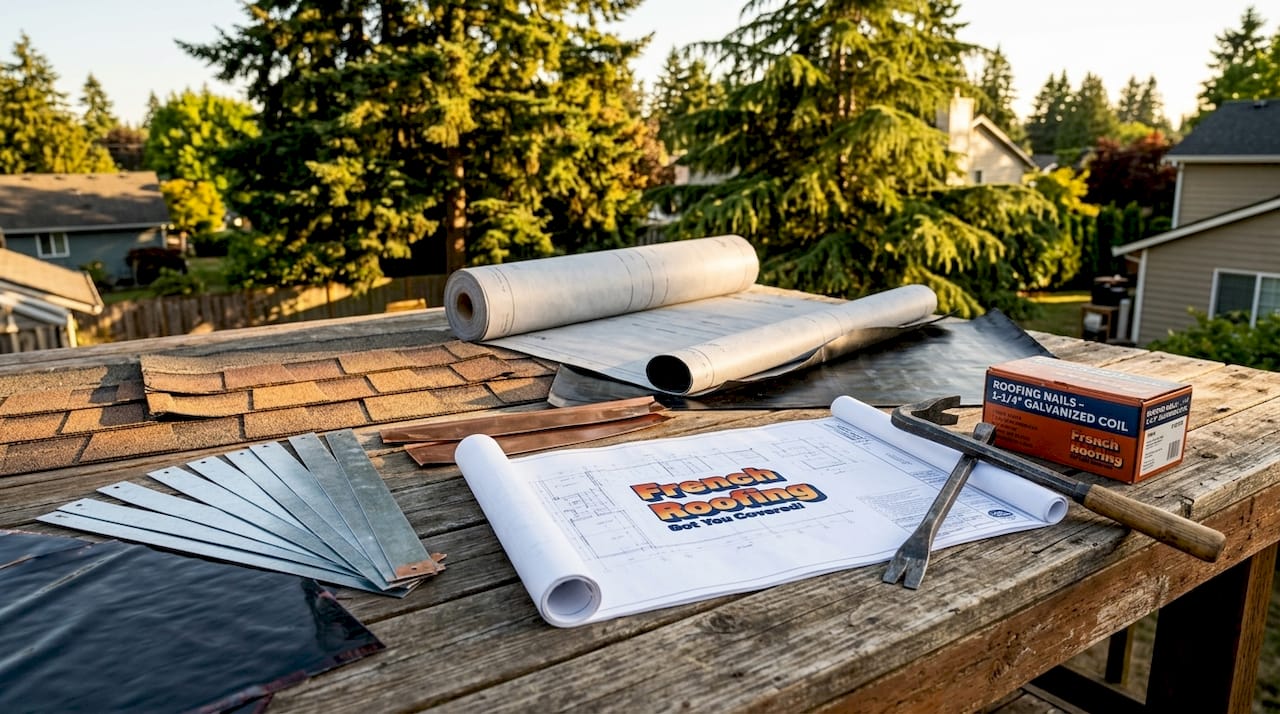
Here's what's typically installed as part of a complete roof replacement:
- Shingles or roofing material: Asphalt shingles are the most common choice for residential homes. Metal, tile, and slate are also options, each with different lifespans and price points. Asphalt shingles generally last 20 to 30 years; metal roofing can last 40 to 70 years.
- Underlayment: This is the water-resistant layer installed directly on the roof deck before shingles go on. It comes in felt or synthetic varieties. Synthetic underlayment is more durable and tear-resistant, which matters during installation.
- Ice and water shield: A self-adhering membrane applied at eaves, valleys, and around penetrations. It's the last line of defense against water intrusion in vulnerable spots.
- Drip edge: A metal strip installed along the roof edges to direct water away from the fascia and into the gutters. It's a small detail that prevents a lot of rot over time.
- Flashing: Metal pieces installed around chimneys, skylights, pipe boots, and roof valleys to seal joints where water would otherwise find a way in.
- Ridge cap shingles: Specially formed shingles that cover the peak of the roof. They're not the same as standard shingles and are designed to flex over the ridge.
- Ventilation components: Ridge vents, soffit vents, and box vents work together to move air through the attic. Proper ventilation reduces moisture buildup and extends shingle life significantly.
A roof replacement quote should list all of these components explicitly, along with manufacturer material warranties (typically 25 to 30 years) and a contractor workmanship warranty covering installation errors.
Pro Tip: Ask your contractor to confirm that ice and water shield is included at all eaves and valleys, not just the minimum code requirement. In the Portland area, where we get plenty of rain, this detail matters.
How does the roof replacement process work, step by step?
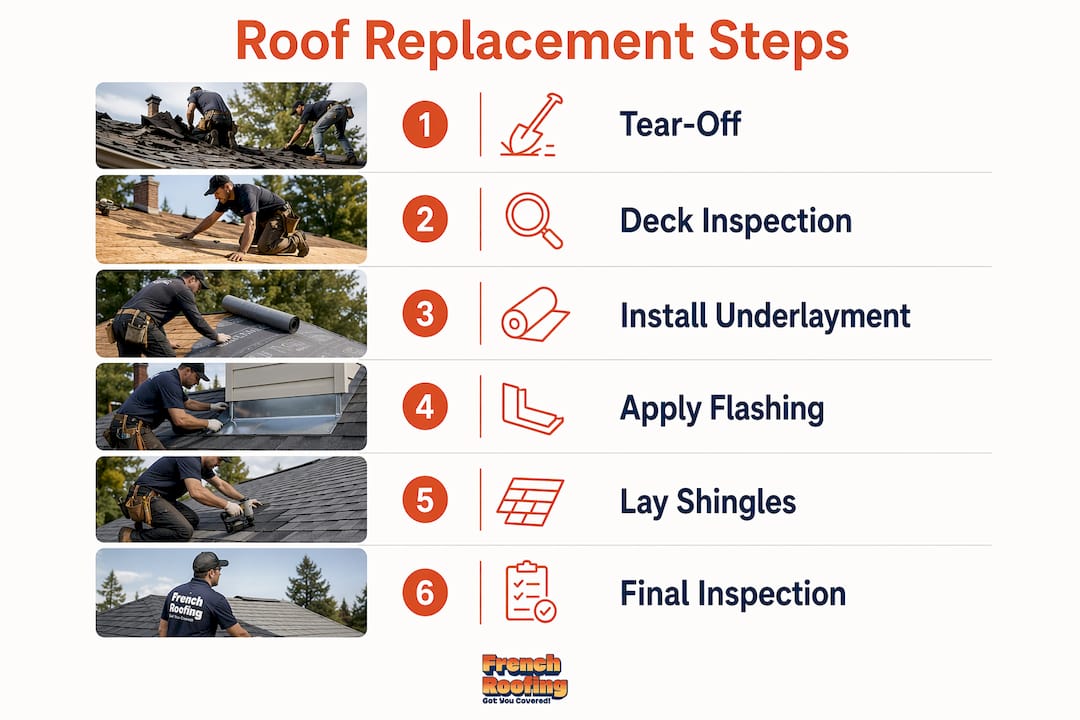
The roof replacement process follows a clear sequence. Understanding each stage helps you know what to expect on the day crews show up at your house.
- Inspection and estimate: A thorough inspection assesses the current roof condition, identifies any decking damage, and documents the scope of work. This is where a good contractor finds problems before they become expensive surprises.
- Site preparation: Crews lay tarps over landscaping, cover HVAC equipment, and set up a dumpster or trailer for debris. Protecting your property during tear-off is a sign of a professional operation.
- Tear-off: The old roofing material is stripped down to the roof deck. Many building codes allow up to two layers of shingles before a full tear-off is required. Roofing over existing layers can void manufacturer warranties, so most reputable contractors won't do it.
- Deck inspection and repair: Once the old material is off, the decking (typically plywood or OSB) is inspected for soft spots, rot, or damage. Damaged decking sheets are replaced to meet building codes and maintain structural integrity.
- Underlayment and ice and water shield installation: These protective layers go down first, starting at the eaves and working up the slope.
- Flashing installation: New flashing is installed around all penetrations and valleys before shingles are applied.
- Shingle installation: Shingles are installed from the bottom of the roof upward, following manufacturer specifications for nailing patterns and overlap. Code-compliant nailing patterns reduce insurance claim risks and are required for warranty validity.
- Ridge cap and ventilation: Ridge caps are installed at the peak, and ridge vents are cut and covered to complete the ventilation system.
- Final inspection and cleanup: Crews do a magnetic sweep for nails, haul away all debris, and walk the property with you to confirm the work is complete.
Pro Tip: Walk the job site with your contractor after tear-off but before new materials go down. That's your best chance to see the deck condition firsthand and understand any additional costs before they're committed.
What extras might not be included in your roof replacement quote?
Base quotes cover the standard scope. Several items are common additions that can affect your final cost, and you need to know about them before signing anything.
- Permit fees: Permits are required when structural work like decking replacement occurs. Fees typically range from $100 to $600 depending on your municipality. Some contractors include this; others bill it separately.
- Decking replacement: Replacing damaged plywood or OSB sheets costs roughly $50 to $100 per sheet. Full redecking can run $3,000 to $5,000 or more. This is almost always a separate line item because no one knows the extent of damage until tear-off is complete.
- Chimney and skylight flashing: Re-flashing a chimney runs $400 to $1,200. Skylight re-flashing costs $300 to $1,500. These are often excluded from base pricing.
- Gutter and fascia repairs: If your fascia boards are rotted, they need to be replaced before drip edge installation. Gutters are typically not part of a roofing quote unless specifically included.
- Solar panel or satellite dish removal and reinstallation: If you have rooftop equipment, it needs to come off and go back on. This is almost always a separate charge.
- Attic insulation or ventilation upgrades: If your attic has inadequate insulation or ventilation, a roof replacement is a good time to address it. Most contractors will quote this separately.
Here's a quick comparison of what's typically included versus what's usually extra:
| Typically included | Usually billed separately |
|---|---|
| Shingles, underlayment, flashing | Decking replacement (per sheet) |
| Ice and water shield | Permit fees (varies by contractor) |
| Drip edge and ridge cap | Chimney or skylight re-flashing |
| Tear-off and debris disposal | Gutter or fascia repairs |
| Standard ventilation components | Solar panel removal/reinstallation |
Getting a written, itemized quote is the only way to know exactly what you're paying for. Detailed written scopes of work with itemized pricing help homeowners avoid misunderstandings about what's included and what may incur extra charges.
How do material choices and roof complexity affect cost?
The cost of roof replacement in 2026 averages around $10,500 to $11,500 for a standard asphalt shingle roof, covering materials, labor, tear-off, disposal, and permits. However, average replacement costs rose 33% in 2025, reaching $17,631 nationally, reflecting inflation in both materials and labor. Your actual number depends heavily on material choice and roof complexity.
| Material | Typical lifespan | Relative cost |
|---|---|---|
| Asphalt shingles (3-tab) | 20 to 25 years | Lowest |
| Architectural asphalt shingles | 25 to 30 years | Low to moderate |
| Metal roofing | 40 to 70 years | Moderate to high |
| Concrete or clay tile | 40 to 50 years | High |
| Slate | 75 to 100+ years | Highest |
Beyond material choice, several factors push costs up or down:
- Labor: Labor accounts for approximately 35 to 45% of total replacement cost. Regional labor markets vary, and the Portland metro area reflects Pacific Northwest pricing.
- Roof pitch: Steeper roofs require more safety equipment and slower installation. Pitch increases can add 25 to 40% to labor costs.
- Multiple layers: Tear-off of additional layers adds $1,500 to $3,000 to the total job cost.
- Warranties: Manufacturer material warranties typically run 25 to 30 years but are prorated after 10 years. Workmanship warranties from the contractor cover installation errors like flashing leaks and range from 2 to 25 years depending on the contractor. A CertainTeed Certified contractor can offer extended warranty coverage that a non-certified installer cannot.
Understanding what CertainTeed Certified means for your warranty coverage is worth a few minutes of reading before you sign a contract.
Key takeaways
A roof replacement covers the full system, not just shingles, and understanding each component protects you from budget surprises and substandard work.
| Point | Details |
|---|---|
| Full system installation | Replacement includes shingles, underlayment, flashing, ventilation, and drip edge as standard components. |
| Extras add up fast | Decking repairs, permits, and chimney flashing are common additions not always in the base quote. |
| Material choice drives cost | Asphalt shingles cost the least upfront; metal and slate cost more but last significantly longer. |
| Labor is nearly half the cost | Labor runs 35 to 45% of total cost, so contractor quality directly affects your investment's value. |
| Get it in writing | An itemized written quote is the only reliable way to know exactly what's included and what isn't. |
What homeowners consistently miss about roof replacements
I've been doing this since 2014, and the thing that catches homeowners off guard most often isn't the price. It's the gap between what they assumed was included and what was actually in the contract.
The deck condition is the biggest wildcard. You genuinely cannot know how much decking needs replacement until the old material is off. I've seen roofs that looked fine from the outside with half the deck rotted through. I've also seen roofs that looked terrible but had solid decking underneath. The honest answer is: budget a contingency for decking repairs, because it's common.
Ventilation is the second thing people underestimate. Effective ventilation is a key but frequently overlooked component that greatly prolongs roof life and prevents costly damage. A new roof installed over a poorly ventilated attic will fail prematurely. It's not exciting to talk about, but it matters more than the brand of shingle in many cases.
On warranties, most homeowners assume the manufacturer warranty covers everything. It doesn't. Manufacturer warranties cover product defects, not labor. If a flashing leak develops two years after installation, that's a workmanship issue. Your contractor's workmanship warranty is what covers it. Ask specifically what the workmanship warranty covers and for how long before you hire anyone.
Finally, cleanup is a real indicator of how a crew operates. A magnetic nail sweep, tarps on the landscaping, and a clean property at the end of the day aren't extras. They're the baseline. If a contractor doesn't mention site protection in their process, that tells you something. You can check our contractor questions checklist for a full list of what to ask before hiring.
— Sean
French Roofing handles the full replacement process for Portland homeowners
French Roofing is a licensed, insured, and CertainTeed Certified roofing contractor serving Damascus, Clackamas, Happy Valley, and the greater Portland metro area. Every roof replacement we complete covers the full scope: inspection, tear-off, deck evaluation, underlayment, flashing, shingles, ventilation, and cleanup. No guessing about what's included.
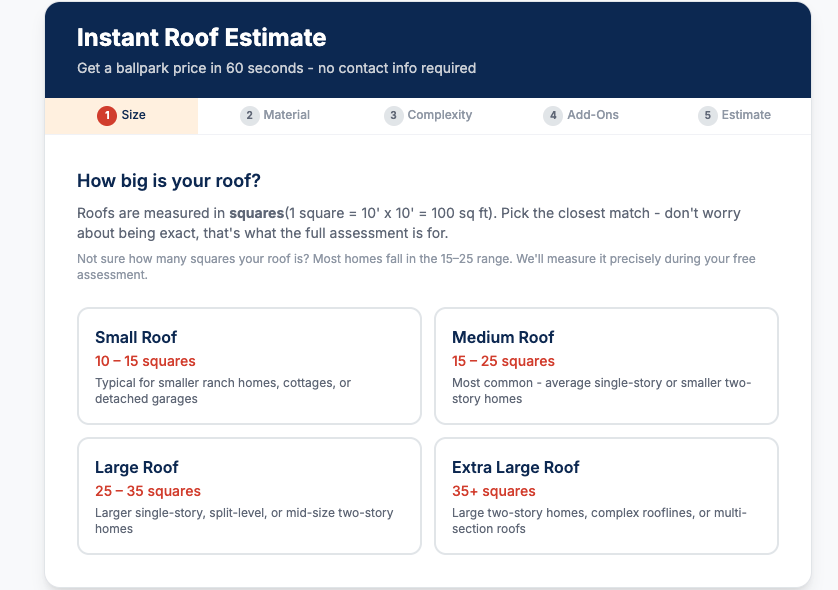
Pricing is transparent and quotes are itemized so you know exactly what you're paying for before work starts. If cost is a concern, financing options are available to help spread the investment over time. French Roofing (CCB #203933) has been treating Portland-area homes like family since 2014.
Get Instant Estimate Online!
FAQ
What is included in a standard roof replacement?
A standard roof replacement includes tear-off of old materials, deck inspection, underlayment, ice and water shield, drip edge, flashing, shingles or other roofing material, ridge cap, ventilation components, and debris cleanup. Manufacturer and workmanship warranties are also standard inclusions.
How long does a roof replacement take?
Most residential roof replacements are completed in one to three days, depending on roof size, pitch, and the extent of any decking repairs needed. Larger or more complex roofs with steep pitches or multiple penetrations can take longer.
Do I need a permit for a roof replacement?
Permits are required when structural work such as decking replacement occurs, with fees typically ranging from $100 to $600 depending on your municipality. Your contractor should pull the permit on your behalf and schedule the required inspections.
What extras are commonly not included in roof replacement quotes?
Decking replacement, chimney or skylight re-flashing, gutter repairs, and permit fees are frequently excluded from base quotes. Always ask for an itemized written quote so you know exactly what's covered before work begins.
How do I know if my roof needs replacement versus repair?
If your roof has widespread shingle failure, significant decking damage, or is approaching the end of its expected lifespan, replacement is usually the better investment. The repair vs. replacement decision depends on the extent of damage, roof age, and long-term cost comparison.
Recommended
- Roof Replacement Financing Benefits For Homeowners | French Roofing Blog | French Roofing
- Roofing Financing Options For Homeowners 2026 Guide | French Roofing Blog | French Roofing
- Roof Replacement | Greater Portland Metro | French Roofing | French Roofing
- Roof Repair vs Replacement Decision Guide for Homeowners