

A roofing subcontractor is defined as an independent specialty-trade contractor engaged by a general contractor (GC) to perform discrete roofing work under a formal subcontract agreement, supplying their own labor and equipment while assuming liability for their defined portion of the project. This role sits at the heart of how residential construction actually gets done. The GC holds the prime contract with the homeowner or developer, then subcontracts roofing work with defined scope, specs, schedule, and payment terms to a roofing specialist. Understanding what a roofing subcontractor role involves, including their responsibilities, contract obligations, and safety duties, is the difference between a project that runs smoothly and one that ends in disputes, failed inspections, or OSHA citations.
What is a roofing subcontractor role in residential projects?
A roofing subcontractor's primary function is to execute technical roofing work within a scope defined by the subcontract agreement, not to manage the overall project. That distinction matters more than most people realize when they're new to the industry.
The day-to-day duties of a roofing subcontractor include:
- Installation and repairs: Applying shingles, underlayment, flashing, ridge caps, and ventilation systems according to manufacturer specifications and project drawings.
- Labor and equipment provision: The subcontractor brings their own crew, tools, and materials unless the contract specifies otherwise. The GC does not supply the workforce.
- Safety compliance: Maintaining fall protection, personal protective equipment (PPE), and hazard controls on the jobsite as required by OSHA standards.
- Cleanup and debris removal: Most contracts require the roofing subcontractor to remove torn-off materials, packaging, and debris from the site at the end of each work day.
- Change order coordination: When scope changes arise, the subcontractor documents and submits change orders through the GC rather than negotiating directly with the homeowner.
- Scheduling coordination: The subcontractor works within the GC's master schedule, communicating delays or conflicts that affect other trades.
Subcontractors also add real value beyond just labor. They provide specialized expertise that many GCs don't maintain in-house, and they offer flexible capacity during busy seasons when a GC's own crew is stretched thin. On residential reroof projects, subcontractors often serve as the installation authority whose adherence to manufacturer specs and documentation directly influences passing inspections and final sign-offs. That's not a small thing. A missed step in the installation sequence can void a manufacturer's warranty before the homeowner ever moves in.
Pro Tip: If you're a GC hiring a roofing subcontractor for the first time, use a contractor questions checklist before signing anything. Confirming license, insurance, and specific roofing experience upfront saves a lot of headaches later.
How do roofing subcontractor contracts define scope, safety, and liability?
The subcontract agreement is where the roofing subcontractor role gets its teeth. A well-written contract protects both parties. A vague one is a lawsuit waiting to happen.
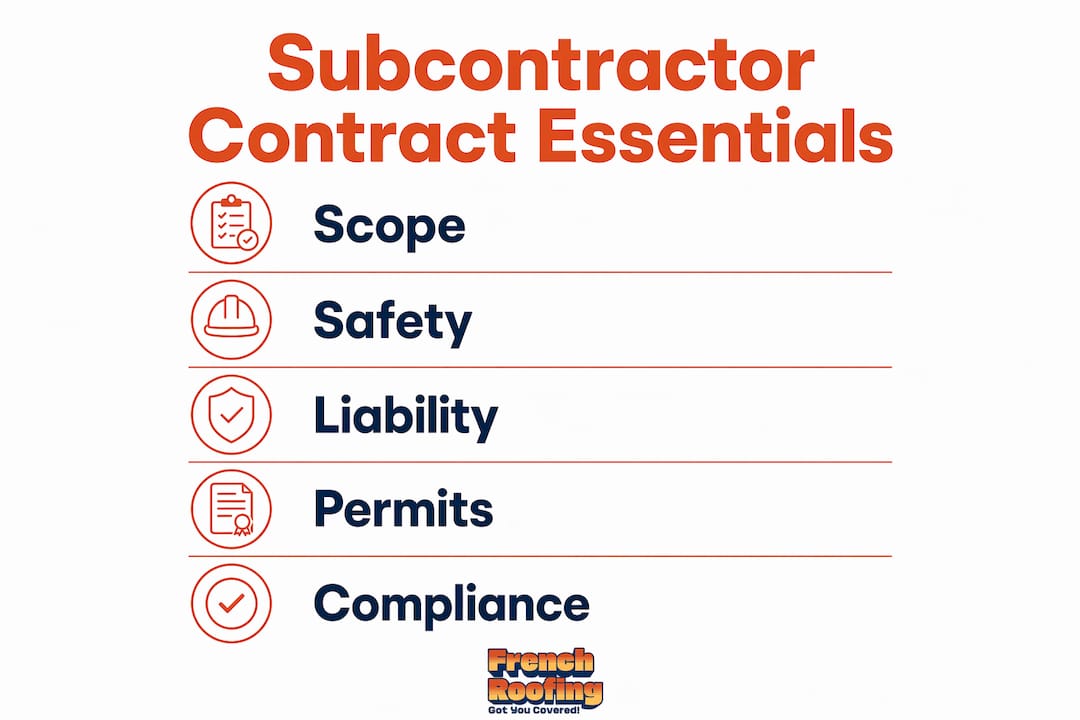
Most subcontract agreements contain the following core provisions:
- Flow-down clauses: These bind the subcontractor to the same plans, specs, safety standards, and change order processes that govern the prime contract between the GC and the project owner. Flow-down provisions also include indemnification language, meaning the subcontractor agrees to defend and hold harmless the GC for claims arising from the subcontractor's own work.
- Detailed scope exhibits: These list exactly what the subcontractor is responsible for, including number of layers to be removed, underlayment type, flashing details, and cleanup obligations.
- Payment terms and lien waivers: The contract specifies when and how the subcontractor gets paid, and usually requires a lien waiver upon payment to protect the property owner.
- Termination clauses: These define the conditions under which either party can end the agreement, and what compensation is owed if work is partially complete.
- Safety and compliance obligations: The contract spells out which safety standards apply and who is responsible for conducting site orientations, toolbox talks, and incident reporting.
The most common source of legal disputes in roofing subcontracts is an ambiguous scope description. Contracts with vague scope such as "re-roof the house" routinely lead to change order disputes over flashing replacement, decking repairs, or skylight work that one party assumed was included and the other assumed was not. Precise scope definition at the bid and contract stage is the single most effective way to prevent those conflicts.
"Clear subcontract provisions specifying flow-down of prime contract terms to subcontractors reduces risk of warranty invalidation and legal disputes in roofing projects." — Roofing Elements Magazine
What role do permits, inspections, and compliance play for roofing subcontractors?
Permit responsibility in roofing is not always obvious, and getting it wrong has real consequences. Permit responsibility can fall either to the general contractor or the roofing subcontractor depending on local jurisdiction and contract terms. When the subcontractor pulls the permit, they become the contractor of record for the roofing scope. That means they bear code compliance and inspection sign-off responsibility directly.
| Scenario | Permit Holder | Contractor of Record | Inspection Responsibility |
|---|---|---|---|
| GC pulls permit | General contractor | General contractor | GC schedules, subcontractor corrects deficiencies |
| Subcontractor pulls permit | Roofing subcontractor | Roofing subcontractor | Subcontractor schedules and corrects |
| Jurisdiction requires trade license | Roofing subcontractor | Roofing subcontractor | Subcontractor bears full compliance burden |
| Design-build with single prime | General contractor | General contractor | GC coordinates all inspections |
Inspections assess installed roofing work against building code regardless of which contractor performed the physical work. Permits and inspections impact manufacturer warranties and financing approvals in roofing projects, so a failed inspection is not just a bureaucratic inconvenience. It can delay a closing or void coverage that the homeowner is counting on.
Roofing subcontractors working under the International Residential Code (IRC) or International Building Code (IBC) must follow specific requirements for underlayment, ice and water shield, ventilation, and fastener patterns. The local Authority Having Jurisdiction (AHJ) holds inspection authority, and the permit holder schedules inspections and corrects any deficiencies before final sign-off.
Pro Tip: Confirm local AHJ requirements before the roofing permit application is submitted. Permit responsibility varies widely by jurisdiction, and assuming the GC handles it when the contract says otherwise is a fast way to end up with an unpermitted roof.
How do OSHA's multi-employer worksite policies affect roofing subcontractors?
Safety on a residential jobsite is shared responsibility, whether the parties involved acknowledge it or not. OSHA's multi-employer citation policy makes that legally binding.
OSHA's multi-employer policy allows general contractors and subcontractors to be cited for the same hazard on shared residential construction sites. More than one employer on-site can receive a citation regardless of who created the hazard, depending on their role as an exposing, correcting, or controlling employer. Here's how those roles break down in practice:
- Exposing employer: An employer whose workers are exposed to a hazard, even if that employer didn't create it. A roofing subcontractor whose crew works near an unguarded floor opening created by another trade is the exposing employer.
- Correcting employer: An employer responsible for correcting a hazard, typically the one who created it or who has the contractual authority to fix it.
- Controlling employer: An employer with supervisory authority over the worksite. General contractors typically hold controlling employer status, which means they can be cited for a subcontractor's safety violations if they had the authority to correct them and failed to act.
Even when subcontractors provide their own crews and equipment, OSHA multi-employer doctrine means GCs and subcontractors share jobsite safety duties including orientations and enforcing fall protection. "We didn't know" is not a defense that holds up with OSHA. The practical takeaway is that GCs need to verify subcontractor safety programs before work begins, and subcontractors need to document their own compliance independently.
Roofing subcontractors specifically face fall hazards that OSHA treats as a priority enforcement area. Guardrails, personal fall arrest systems, and safety nets are the three accepted methods of fall protection for residential roofing under OSHA 29 CFR 1926.502. Subcontractors who skip these controls put their own workers at risk and expose the GC to citation liability at the same time.
Key takeaways
A roofing subcontractor's role is defined by the subcontract agreement and covers labor, equipment, safety compliance, permit responsibility, and technical installation, all within a scope set by the general contractor.
| Point | Details |
|---|---|
| Defined scope is everything | Vague contracts like "re-roof the house" cause disputes; detailed scope exhibits prevent them. |
| Permit holder bears compliance burden | Whoever pulls the permit becomes contractor of record and owns inspection sign-off responsibility. |
| OSHA liability is shared | GCs and subcontractors can both be cited for the same hazard under multi-employer policy. |
| Manufacturer specs drive warranty validity | Subcontractor installation quality and documentation directly affect whether warranties hold up. |
| Flow-down clauses bind subcontractors | Prime contract terms, safety standards, and indemnification flow down to the subcontractor automatically. |
What I've learned about roofing subcontractor roles after years in the field
Here's something that surprises a lot of people new to the industry: the biggest problems on roofing projects rarely come from bad workmanship. They come from unclear expectations baked into a contract that nobody read carefully enough before the job started.
I've seen GCs assume the subcontractor would handle permits, and subcontractors assume the GC would. Nobody pulled the permit. The roof passed visual inspection but failed the final sign-off because there was no permit on file. That's a fixable problem, but it costs time and money and creates real stress for the homeowner.
The other thing I'd push back on is the idea that managing roofing subcontractors is just about showing up and checking the work. The safety piece is where GCs get caught off guard. OSHA's multi-employer rules mean that if a subcontractor's crew is working without proper fall protection and an inspector shows up, the GC is in the conversation too. Knowing that going in changes how you set up your pre-construction meetings and what you put in your subcontract agreements.
For construction professionals and newcomers alike, the most useful thing you can do is treat the subcontract as a working document, not a formality. Review the scope exhibit line by line. Confirm who holds the permit. Verify the subcontractor's insurance certificates name you as an additional insured. And do a safety orientation before the first nail goes in. Those four steps prevent the majority of problems I've seen on residential roofing projects over the years.
If you're a homeowner trying to understand whether your contractor is using subcontractors, ask directly. A reputable contractor will tell you, and they'll be able to explain how those subcontractors are vetted, insured, and supervised. That transparency is a good sign.
— Sean
How French Roofing approaches subcontractor quality and accountability
When French Roofing takes on a roof replacement project in Damascus, Happy Valley, Clackamas, or anywhere in the greater Portland metro, every subcontractor we work with is licensed, insured, and held to the same CertainTeed Certified installation standards we apply to our own crew. We don't hand off a job and walk away. Permits, inspections, and safety compliance are confirmed before work begins, not after something goes wrong.
We serve homeowners across the Portland metro area who want a straight answer about who's on their roof and what they're doing there. If you want to know exactly what goes into a properly managed roofing project, we're happy to walk you through it.
Get Instant Estimate Online!
FAQ
What is a roofing subcontractor?
A roofing subcontractor is an independent specialty contractor hired by a general contractor to perform specific roofing work under a subcontract agreement, supplying their own labor, equipment, and liability for their defined scope.
What does a roofing subcontractor do on a residential project?
Roofing subcontractor tasks include installation, repairs, safety compliance, cleanup, and change order coordination, all within the scope and schedule set by the general contractor's prime contract.
Who is responsible for pulling the roofing permit?
Permit responsibility depends on local jurisdiction and contract terms. When the roofing subcontractor pulls the permit, they become the contractor of record and bear code compliance and inspection sign-off responsibility for the roofing scope.
Can a general contractor be cited by OSHA for a subcontractor's safety violation?
Yes. Under OSHA's multi-employer citation policy, a general contractor holding controlling employer status can be cited for a subcontractor's safety hazards if they had the authority to correct them and failed to do so.
What should a roofing subcontract agreement include?
A roofing subcontract should include a detailed scope exhibit, flow-down clauses from the prime contract, payment terms, lien waivers, safety obligations, and termination conditions to prevent disputes and protect both parties.